Chemical Resistant Plastic Balls for Industrial Roll-On Applicators

Manufacturer of HDPE and PP roller balls with high chemical resistance for applicators of lubricants, solvents, adhesives, industrial marking inks, and anti-corrosive products. ISO 9001 certified. Capacity: 11 million units/month.

Precision Plastic Components for the Chemical Industry

Chemical product manufacturers rely on roll-on applicators as a controlled dispensing method for products that demand precise, localized application: machinery lubricants, solder flux, contact adhesives and cyanoacrylate adhesives, industrial and livestock marking inks, liquid shoe polish, liquid sports chalk, anti-corrosive products, and degreasers.

Unlike cosmetic applicators, roller balls for industrial chemical use face significantly more aggressive compounds: organic solvents, acids, bases, hydrocarbons, and extreme temperatures. This demands a material with verified chemical resistance and dimensional stability under industrial conditions.

Molding S.A.S. manufactures its balls in virgin HDPE and PP selected specifically for their proven chemical resistance. We use no recycled resin or additives that could weaken the material's mechanical properties when exposed to aggressive chemicals. We are the only manufacturer of hollow plastic roll-on balls in Colombia, with dimensional verification in a Mitutoyo metrology lab.
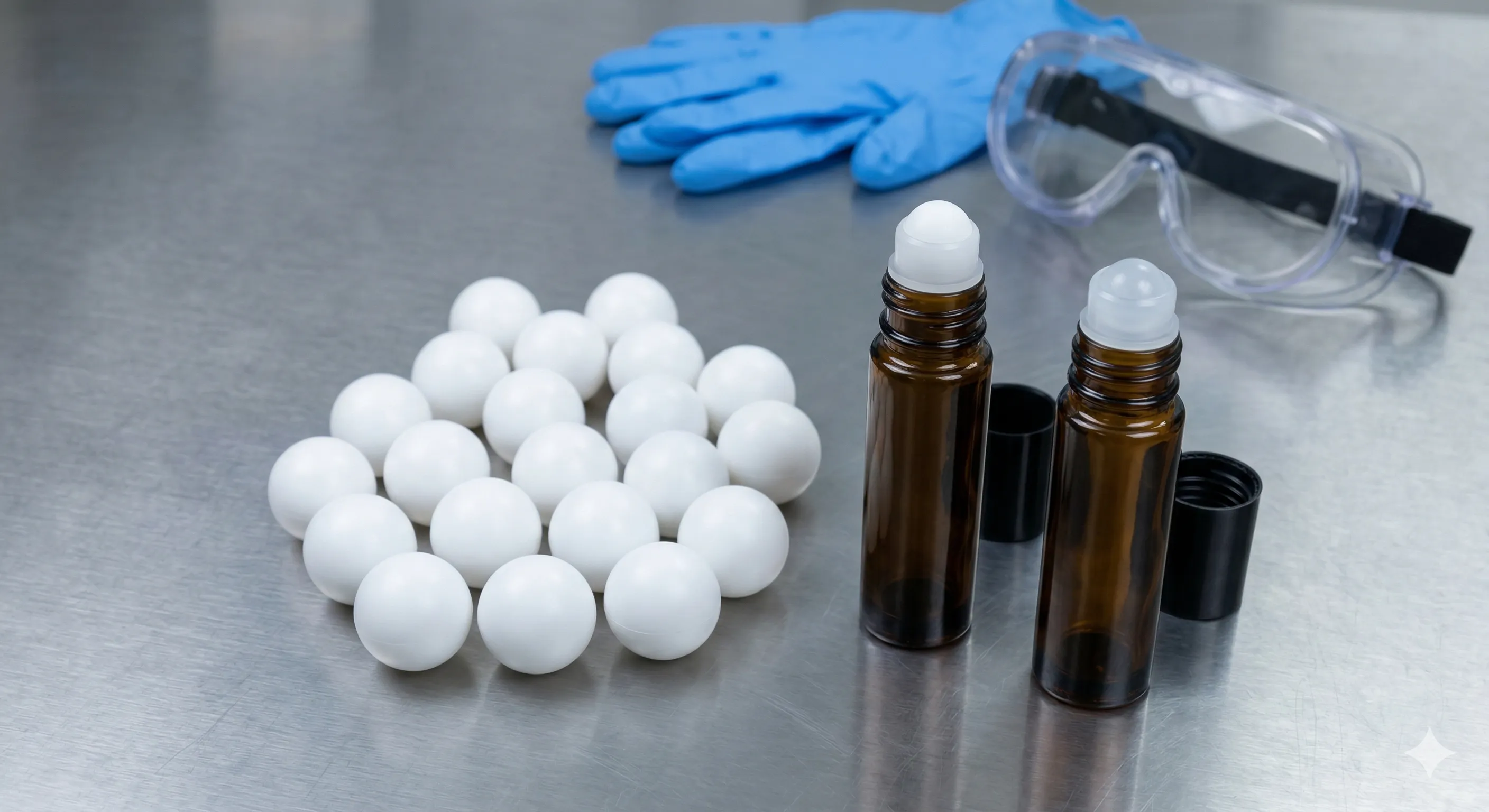
Chemical resistant plastic balls for industrial roll-on applicators

Industrial Roll-On Applicator Balls: Uses in the Chemical Industry

The roll-on format solves real problems for chemical manufacturers: waste-free dosing, localized application without operator exposure, and sealed storage that prevents evaporation and contamination.

Industrial Lubricants and Oils

Precision application of lubricants on bearings, gears, hinges, and mechanisms where excess lubricant is as harmful as too little. The roll-on delivers the exact amount at the exact point, with no spills or waste. HDPE is the ideal material thanks to its complete resistance to mineral and synthetic oils.

Solder Flux and Adhesives

Liquid solder flux for electronics and contact adhesives require precise application in tight areas. Roll-on balls for adhesives eliminate brushes and open dispensers that cause waste, product contamination, and operator exposure to vapors. PP balls provide the chemical inertness needed against resins and activators.

Anti-Corrosives and Surface Treatments

Anti-corrosive products, rust inhibitors, strippers, and surface treatments are applied with roll-ons to protect metal parts, electrical connections, fasteners, and exposed surfaces. The format allows direct, brush-free application with uniform coverage and no contamination of the product remaining in the container.

Chemical Resistance of PP and HDPE Roller Balls to Solvents and Industrial Compounds

Chemical compatibility table for our materials against the compounds most common in industrial applications. This table is a guideline — for specific formulations, we recommend validation with technical samples.

Chemical Compound PP HDPE
Mineral oilsGoodExcellent
Synthetic oilsGoodExcellent
Alcohols (methanol, ethanol, isopropanol)ExcellentExcellent
Hydrochloric acid (diluted)ExcellentExcellent
Sulfuric acid (diluted)GoodGood
Sodium hydroxide (NaOH)ExcellentExcellent
AmmoniaExcellentExcellent
Aliphatic hydrocarbons (hexane, heptane)ModerateGood
Esters (ethyl acetate)ModerateModerate
Ketones (acetone, MEK)Moderate — may swellModerate — may swell
Aromatics (toluene, xylene)Limited — requires validationLimited — requires validation
Strong oxidizing acids (concentrated HNO₃)Not recommendedNot recommended

Important: Chemical resistance depends on concentration, temperature, and exposure time. For formulations containing aromatic solvents, strong ketones, or concentrated oxidizing acids, we recommend compatibility testing with our technical samples before finalizing the production specification. See the full PP vs HDPE comparison →

Advantages of the Roll-On Format for Industrial Chemical Products

The roll-on format delivers concrete operational advantages over conventional application methods (brush, spray, pouring) in industrial environments:

  • Precise dosing: The ball controls the volume of product dispensed per pass, eliminating the waste generated by brush application or direct pouring
  • Reduced exposure: The operator never touches the chemical directly — the ball acts as a barrier between the contents and the skin
  • Airtight seal: The container stays sealed when not in use, preventing solvent evaporation, particle contamination, and product degradation
  • Localized application: The product goes exactly where it is needed, without affecting adjacent surfaces
  • Portability: The roll-on format is compact and travels easily in maintenance kits, toolboxes, and workstations
  • Less waste on the books: Less product wasted per application = lower consumption = lower operating cost
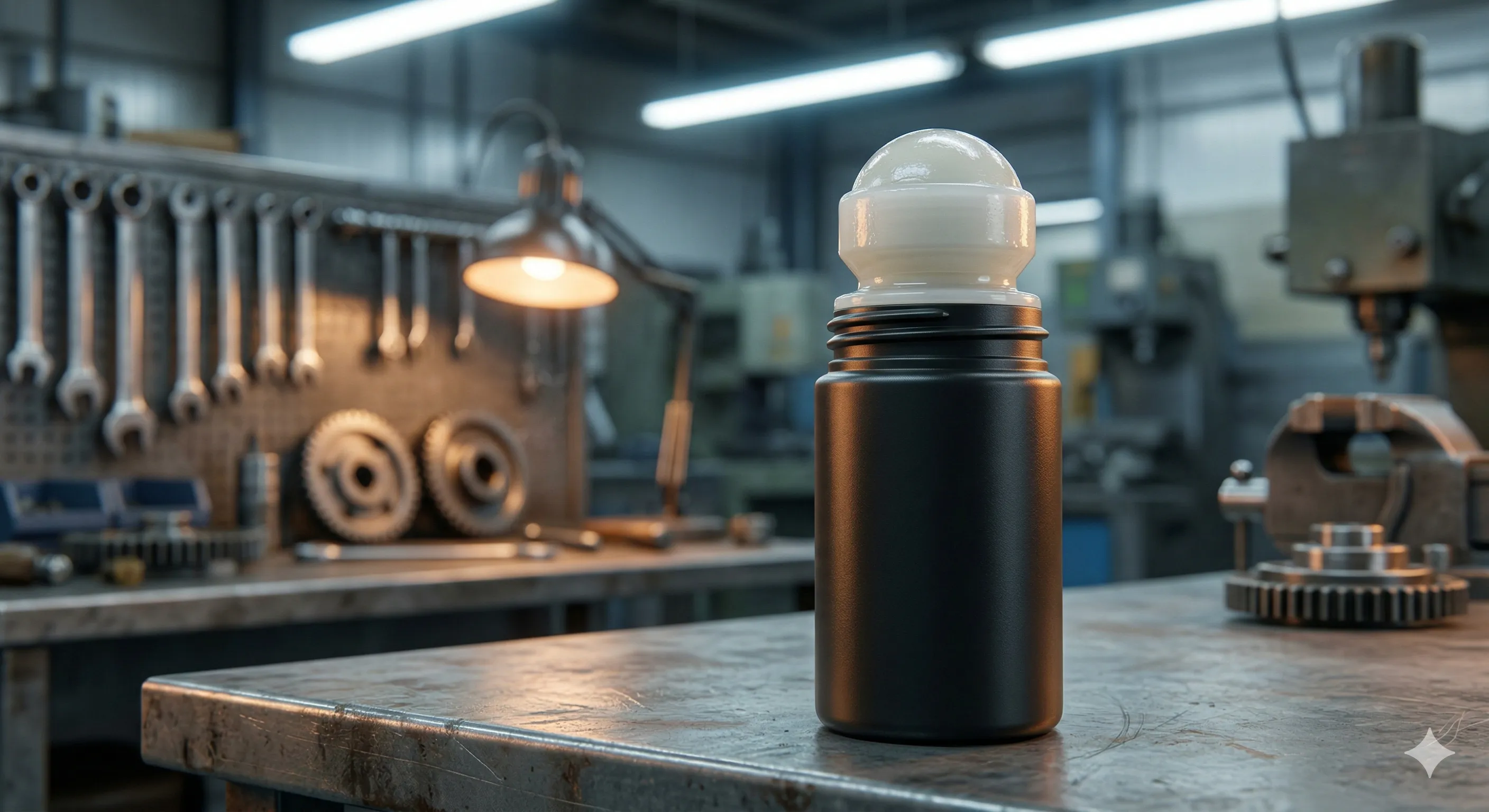
Industrial roll-on applicator with HDPE roller ball for chemical products

Material Selection for Chemical Applications: HDPE as the Standard

For most applications in the chemical industry, HDPE is the default recommended material. Here is why:

Broader Overall Chemical Resistance

HDPE resists a wider spectrum of chemical compounds than PP, especially hydrocarbons, mineral oils, and aliphatic solvents. It is the industry-standard material for chemical product packaging.

Better Low-Temperature Performance

With an operating range reaching -40°C, HDPE keeps its mechanical properties in unconditioned warehouses, shipping containers, and industrial environments with significant thermal variation. PP becomes brittle below -10°C.

Low Absorption

HDPE absorbs less liquid than PP, which prevents dimensional swelling of the ball while in permanent contact with solvents inside the container. This guarantees that the fit to the bottle neck holds for the product's entire shelf life.

Does your formulation contain aromatic solvents or strong ketones? Request samples for compatibility validation →

Frequently Asked Questions: Plastic Balls for the Chemical Industry

Technical answers for process engineers, industrial purchasing managers, and chemical product formulators.

HDPE offers excellent resistance to most common industrial solvents: alcohols, esters, and aliphatic hydrocarbons. For chlorinated or strong aromatic solvents (toluene, xylene), specific validation with samples is required. PP has comparable resistance but is less tolerant of extreme temperatures.

HDPE is the recommended material for industrial lubricants due to its excellent resistance to mineral oils, greases, and hydrocarbons, and its low absorption. It withstands industrial storage conditions without degradation or dimensional deformation.

Yes. PP and HDPE have excellent resistance to weak and moderate acids (diluted HCl, diluted H₂SO₄, H₃PO₄) and to bases (NaOH, KOH, ammonia). For concentrated acids or strong oxidizers, specific validation is required.

Roll-ons are used across the chemical industry to apply precision lubricants, solder flux, contact adhesives and cyanoacrylate adhesives, industrial marking inks and livestock identification inks (veterinary roll-on), liquid shoe polish, liquid sports chalk, anti-corrosive products, industrial repellents, and spot degreasers.

HDPE operates from -40°C to 80°C — suitable for industrial environments with thermal variation. PP operates from -10°C to 100°C, better at high temperatures but with lower tolerance to extreme cold.

Yes. HDPE balls are compatible with most anti-corrosive formulations based on oils, waxes, and corrosion inhibitors. The roll-on enables localized application on metal parts, connections, and exposed surfaces without waste. More about OEM manufacturing →

Need Plastic Balls for Chemical Product Applicators?

Request technical samples to validate compatibility with your formulation. Material and diameter selection guidance at no cost.